
 By
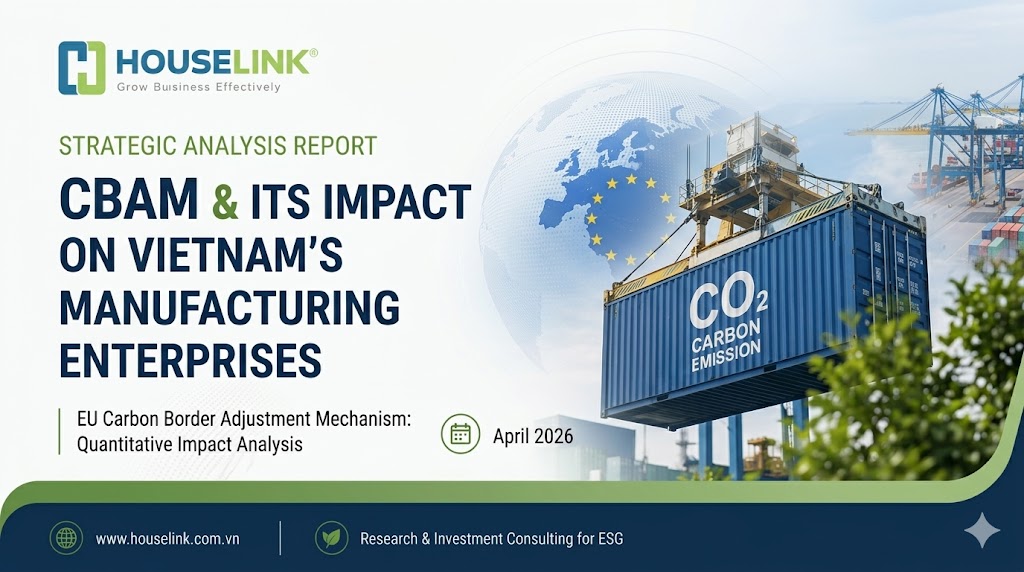
By Hanoi, April 2026 — HOUSELINK Joint Stock Company has officially released its strategic analysis report titled “CBAM & Its Impacts on Vietnamese Manufacturing Enterprises,” providing a comprehensive assessment of the European Union’s Carbon Border Adjustment Mechanism (CBAM) following its official implementation on January 1, 2026.
According to the report, the CBAM certificate price in Q1/2026 reached €75.36 per ton of CO₂, as announced by the European Commission on April 7, 2026, pursuant to Regulation (EU) 2023/956 and Implementing Regulation 2025/2548. The CBAM phase-in rate is set to increase progressively from 2.5% in 2026 to 100% by 2034, in alignment with the phase-out of free allowances under the EU ETS. This trajectory is expected to create significant and escalating financial pressure on exporters to the EU market.
Four out of six CBAM sectors involve Vietnamese enterprises
Vietnam currently exports approximately USD 50 billion annually to the EU, with four CBAM-covered sectors — steel, aluminum, cement, and fertilizers — all having active participation from domestic enterprises. The report highlights several critical impacts:
- BF-BOF steel: CBAM costs in 2030 are estimated at approximately €133.8 per ton, exceeding operating EBITDA (€32–65/ton) by 2 to 4 times. By 2034, costs could reach around €345/ton, equivalent to 50–63% of HRC export prices.
- Coal-powered electrolytic aluminum: CBAM costs by 2034 could rise to approximately €2,100 per ton, accounting for nearly 90% of selling prices, effectively rendering exports to the EU economically unviable.
- Vietnam’s grid emission factor: Recorded at 0.66 kgCO₂/kWh in 2023 (Department of Climate Change, Official Letter No. 1726/BĐKH-PTCBT), this is three times higher than the EU average (0.22 kgCO₂/kWh) — further exacerbating the disadvantage for EAF steel and electrolytic aluminum.
The report also notes that Vietnam’s ETS pilot phase (2025–2028 under Decree No. 119/2025/NĐ-CP) has not yet been recognized by the EU for CBAM offsetting. Meanwhile, competing countries such as South Korea (K-ETS) and China (CN-ETS) are likewise awaiting the EU’s finalized recognition framework.
2026–2028: A critical window for action
HOUSELINK emphasizes that the period from 2026 to 2028, when the CBAM phase-in rate remains relatively low at 2.5–10%, represents a crucial window for Vietnamese enterprises to establish Measurement, Reporting, and Verification (MRV) systems and Product Carbon Footprint (PCF) frameworks at comparatively low cost.
Two priority actions are recommended:
- Invest in PCF measurement and ISO 14067 verification, with estimated costs ranging from USD 15,000 to 50,000, to avoid the application of default values that are 30–50% higher than actual emissions (under Implementing Regulation 2025/2621);
- Enter Direct Power Purchase Agreements (DPPA) with renewable energy producers to reduce Scope 2 emissions — a solution with near-zero incremental cost that could lower CBAM costs for EAF steel in 2030 from approximately €78/ton to €26/ton.